Inside Studio20: Budapest’s Lagree Studio, and the Machine That Makes It Work
Andrássy út doesn’t really do gyms. It does Opera, café terraces, embassies, and some of the most photographed façades in Budapest. So when a boutique fitness studio opens inside the Callas House, a few doors down from the Opera House, in the kind of building most people associate with high ceilings and string quartets rather than spring-loaded resistance machines, it’s worth asking what it’s actually doing there.
The answer, once you’ve taken a class, stops being a question. Studio20 is built around the Lagree Method — and after forty-five minutes on the machine at the center of the room, the “why” answers itself, somewhere around the time your legs start to shake.
The "why" answers itself, somewhere around the time your legs start to shake.

The Logic of Time Under Tension
Sébastien Lagree wasn’t trying to invent a new fitness category. In the late 1990s he was teaching Pilates in Los Angeles and kept running into the same complaint: clients wanted something that actually built muscle, not just a gentler way to stretch and stabilize. Rather than bolt weights onto a reformer, he rebuilt the equipment and the method from the ground up, and over the following years it evolved into something that borrowed Pilates’ precision but ran on an entirely different engine — what’s now generally referred to as time under tension.
The principle is almost suspiciously simple: a muscle that never gets to rest, and never gets help from momentum, fatigues faster and more thoroughly than one doing fast, bouncy reps. So in a Lagree class, nothing is fast. Beginners typically move on a four-count tempo — roughly two seconds out, two seconds back — and as people progress, that same movement can stretch out until a single rep takes the better part of a minute. Multiply that across a 45- to 50-minute class with almost no rest between exercises, and you get sets that frequently run past sixty seconds of continuous load, recruiting both the fast-twitch fibers responsible for strength and the slow-twitch fibers responsible for endurance, more or less at the same time.
It’s also why nobody who’s done Lagree describes the shaking as a bad sign. The tremor shows up when a muscle is working at the edge of what it can sustain — which, inconveniently, is exactly the zone where most of the adaptation happens.
Not Pilates, Though It Borrows the DNA
The comparison to Pilates is fair and a little misleading at the same time. Both use a sliding carriage, both demand precise form, and both put the core at the center of almost every movement. But where classical reformer Pilates is built around mobility, alignment, and a relatively gentle resistance curve, Lagree turns the resistance up, slows the tempo down, and asks the same muscles to hold position under real load for much longer stretches — including isometric holds that, beyond the strength benefit, are increasingly discussed for their role in maintaining bone density as people age.
The practical result is a workout that sits in a strange and useful gap: harder than most people’s mental image of “machine Pilates,” considerably easier on the knees, hips, and spine than running or heavy barbell work, and unusually good at training the small stabilizing muscles that conventional strength training tends to skip past entirely. Those are the muscles that quietly determine whether you can get off the floor gracefully at sixty, carry groceries up four flights without your back complaining, or stand for a full day without your shoulders rounding forward by 16:00.
The Machine: Lagree MegaPro
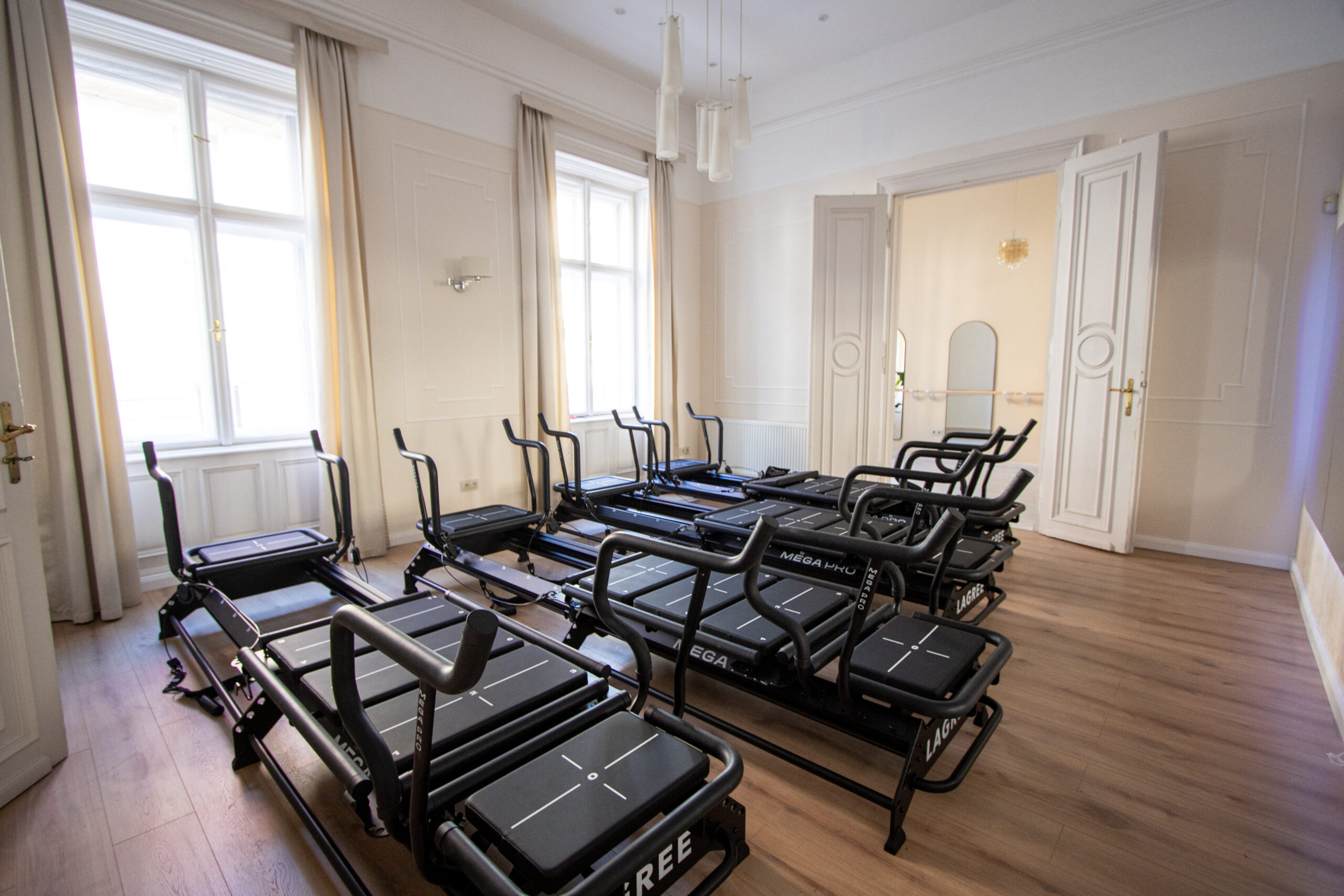
None of this works without precise, well-engineered resistance, which is the entire reason the equipment matters as much as the method. Studio20 trains on the Lagree MegaPro, the most recent Megaformer in the line and, depending who you ask, the most refined one yet.
The MegaPro is essentially a synthesis of everything Lagree Fitness learned from its earlier flagship machines, the M3 and the EVO — built on the same frame as the M3 for stability and footprint, but with the cleaner, lower-profile look of the EVO series. A few details matter more than they might sound:
- An eight-spring resistance system, including an ultra-light “silver spring” option, so a complete beginner and a three-year Lagree regular can train on the same machine, at the same time, with the resistance dialed to where each of them actually is — not where a single fixed setting happens to land.
- Reworked platforms and handles, designed for cleaner alignment during longer holds, which matters more than it sounds once you’re forty seconds into a static lunge.
- A noticeably smoother carriage glide, which keeps tension consistent through the full range of motion instead of letting it spike at the end of a rep or go slack at the start of the next one — exactly the kind of detail that determines whether “time under tension” is a real training stimulus or just a slogan.
- A wider set of hand and foot placements, which is what allows one machine to produce dozens of distinct exercises rather than a handful repeated on a loop.
Similar equipment. Completely different challenge.
The net effect is a machine that an instructor can reprogram in seconds — same equipment, completely different challenge — which is part of why studios that take their Lagree programming seriously have gravitated toward it.
Inside Studio20
The studio itself plays the same game as the machine: understated, but considered. Set inside the Callas House on Andrássy út, the space leans toward the boutique-hotel end of fitness design rather than the fluorescent-lit gym end, and classes are kept deliberately small — the kind of group size where an instructor actually has time to walk over, adjust your spring tension, and fix your foot placement before you finish the set, rather than calling out corrections to the room in general.
That matters more in Lagree than in most formats, because so much of the method’s effectiveness comes down to precision. A few degrees of difference in hip alignment can be the difference between a move that targets your glutes and one that just irritates your lower back. Small classes are less of a luxury here and more of a quiet design decision that determines whether people actually get the results the method promises.
Who Actually Walks Through the Door
In practice, it tends to be a fairly wide mix. People who sit at a desk all day and want to undo what that does to their posture. People with a cranky knee or a lower back that’s ruled out running, who still want something genuinely intense. Athletes looking for a stabilizing, low-impact complement to their main sport. And a fair number of complete beginners who’ve never set foot on a reformer of any kind, but who’ve heard enough about the shaking to be curious.
None of those groups need to arrive “fit.” The ultra-light spring option exists specifically so a first class isn’t a discouraging experience, and the format is built to scale with you rather than around you — the same machine that humbles a beginner in week one is still offering something new in month six, just with the resistance and tempo turned up.
The same machine that humbles a beginner in week one still has something new to offer in month six.
Worth Fifty Minutes
There’s a reason boutique Lagree studios took off first in Los Angeles, then New York, then London, before the format started showing up in cities like Budapest: it solves a fairly specific problem — an effective, full-body, joint-friendly workout that doesn’t demand an hour and a half — better than most of the alternatives. Studio20 brings that same idea to one of the city’s most striking buildings, on a machine designed to make the method work as intended.
The honest way to find out whether it’s for you isn’t to read another paragraph about it. It’s to book a class, step onto the MegaPro, and see how your legs feel around minute thirty.
Book a class, step onto the MegaPro, and see how your legs feel around minute thirty.